



In baccarat, you bet on which of two hands will finish closer to 9. The hands are called Player and Banker, and you can also bet that they’ll finish with the same score. In the standard casino version, called Punto Banco, the rules decide whether either hand gets a third card.
How to play baccarat step by step
- Place your bet on Player, Banker or Tie before the deal.
- Each hand gets two cards. An opening total of 8 or 9 is called a natural. If either hand has one, the deal ends there.
- If neither hand has a natural, the dealer follows the third-card rules. Either hand can receive at most one more card.
- Compare the final scores. The higher score wins. If the scores match, Tie bets pay out and Player and Banker stakes are returned.
Baccarat card values and scoring
| Card | Points |
|---|---|
| Ace | 1 |
| 2 to 9 | Face value |
| 10, Jack, Queen or King | 0 |
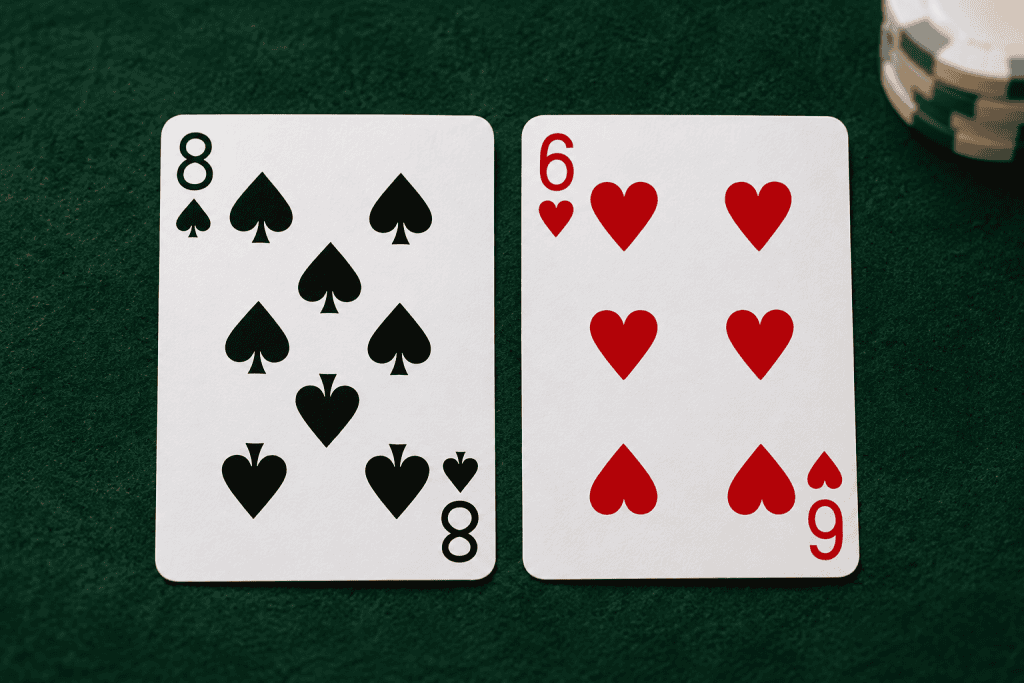
Add the card values and keep the last digit. An 8 and a 6 add up to 14, so the hand scores 4. A king and a 7 score 7 because the king is worth zero. Suits don’t affect the score.
A baccarat round explained
Say you bet $10 on Player. Player gets a 2 and a 3 for a total of 5. Banker gets an ace and a 5 for a total of 6.
Player draws a 4, bringing its score to 9. With an opening total of 6, Banker would draw only if Player’s third card were a 6 or a 7. The 4 leaves Banker on 6. Player wins 9 to 6, and you get $20 back: your $10 stake plus $10 in profit.
Baccarat third-card rules
Check for a natural 8 or 9 first. If either opening hand has one, both hands stand. Otherwise, Player draws on 0 to 5 and stands on 6 or 7.
If Player stands, Banker draws on 0 to 5 and stands on 6 or 7. If Player draws, the table below shows when Banker draws.
| Banker’s opening score | Banker draws when Player’s third card is worth |
|---|---|
| 0 to 2 | Any value |
| 3 | Any value except 8 |
| 4 | 2 to 7 |
| 5 | 4 to 7 |
| 6 | 6 or 7 |
| 7 | Banker always stands |
A 10 or face card counts as 0 in this table.
Baccarat bets, payouts and house edge
The table assumes eight decks, a 5% commission on Banker wins and an 8-to-1 Tie payout. The $10 examples show your profit before adding back your stake.
| Bet | When it wins | Net payout | Profit on a winning $10 bet | House edge |
|---|---|---|---|---|
| Banker | Banker finishes closer to 9 | 0.95 to 1 | $9.50 | 1.06% |
| Player | Player finishes closer to 9 | 1 to 1 | $10.00 | 1.24% |
| Tie | Both hands finish with the same score | 8 to 1 | $80.00 | 14.36% |
Banker has the lowest house edge under these rules. A 1.06% house edge means the expected loss is about $1.06 for every $100 wagered over many rounds. A winning Tie pays $80 on a $10 bet, but it carries a much higher house edge.
How to play baccarat online
A live dealer deals physical cards on a video stream. A computer-dealt game uses a random number generator to deal virtual cards. In either format, choose a chip value and select Player, Banker or Tie before betting closes. OnlineCasino.org guide to live casinos

Open the paytable and check the Banker commission, the Tie payout and the limits for the bet you want to place. Side bets such as Player Pair and Banker Pair have separate payouts.
On a no-commission table, check what happens when Banker wins with a 6. In one common version, that outcome pays $5 in profit on a $10 Banker bet. Other variants can use different rules.
If the game has a demo, use it to find the betting spots and follow a round without risking money. If you play for real money, set a spending limit before you start. Stick to it if you lose.
Can a baccarat scoreboard predict the next hand?
The scoreboard records results. A run of Banker wins gives you no reliable way to tell what will happen next. Doubling your stake after a loss puts more money at risk. The house edge stays the same.